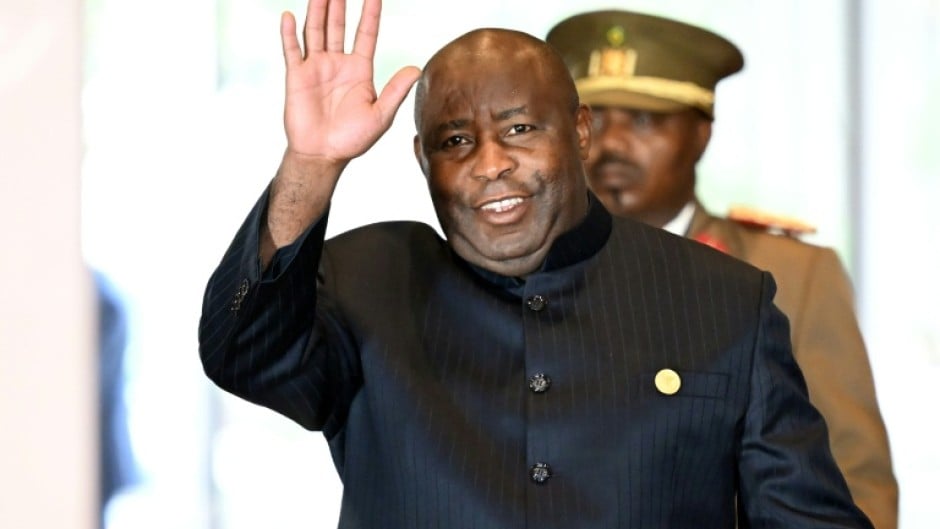
Burundi’s head of state, Évariste Ndayishimiye, has been officially selected by his governing party to stand in the country’s next presidential election scheduled for the coming year.
The 57-year-old leader has been in office since 2020, when he assumed power after the sudden death of longtime ruler Pierre Nkurunziza. His party, the CNDD-FDD, confirmed via social media that he will represent them in the race for a new seven-year term, although the exact election date has yet to be announced.
Responding to the endorsement, Ndayishimiye expressed appreciation to party supporters for their confidence in his leadership. He indicated his intention to continue pursuing the policies already underway, emphasizing a vision of stability and shared progress for the nation.
A former army general and once a senior figure within the ruling party, Ndayishimiye is widely regarded as the leading contender ahead of the vote. His initial victory in May 2020 was overshadowed by allegations of electoral irregularities and the exclusion of key opposition figures.
Criticism has already emerged from opposition groups. Epitace Nshimirimana, speaking on behalf of the Movement for Solidarity and Development (MSD), argued that the forthcoming election is unlikely to meet global democratic benchmarks. He accused the current administration of failing to address essential economic challenges, including shortages of fuel and foreign currency, as well as limited access to basic goods.
According to Nshimirimana, extending Ndayishimiye’s leadership for another term could deepen the country’s economic struggles and further weaken national systems.
Since taking office, Ndayishimiye has alternated between efforts to introduce reforms aimed at reducing the dominance of military elites and maintaining tight political control. International organisations, including the United Nations, along with various human rights groups, have continued to raise concerns over alleged abuses in the country.
Burundi, a landlocked nation with a population of around 15 million, remains one of the poorest globally. Recent developments have added to the uncertainty. The country’s communications minister died earlier this month in what authorities described as a road accident, though reports suggest the circumstances are still under review.
In another notable development, former prime minister Alain-Guillaume Bunyoni was released on medical grounds after serving part of a life sentence related to an alleged coup attempt. Once a powerful figure in government, Bunyoni held the premiership from 2020 until his dismissal in 2022, shortly after claims surfaced of a plot against the president.
Burundi continues to grapple with the legacy of the 2015 political unrest that followed Nkurunziza’s controversial bid for a third term. That period was marked by widespread violence, including killings, enforced disappearances, arbitrary arrests, and other serious human rights violations. According to findings by the International Criminal Court, the turmoil resulted in over 1,200 deaths and forced tens of thousands to flee the country.
At present, Ndayishimiye also serves as the rotating chairperson of the African Union, a role he assumed in February for a one-year term.