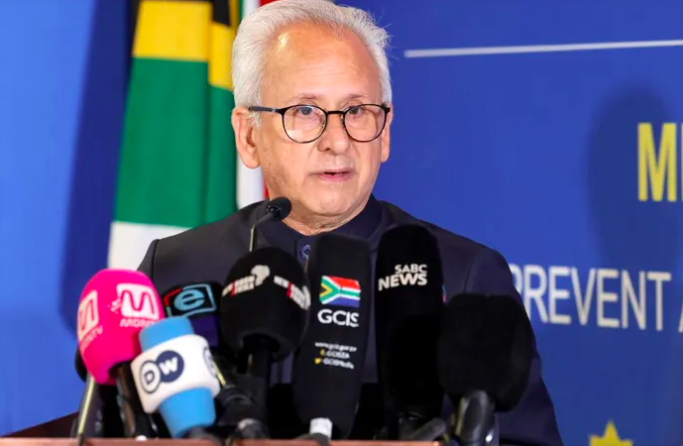
Acting Police Minister Firoz Cachalia says the government will not pursue a state of emergency in response to illegal immigration concerns, despite growing alarm after the arrest of a foreign national allegedly found with military-grade explosives earlier this year.
Cachalia said the issue of undocumented migration and related criminal activity cannot be resolved through temporary emergency powers, arguing that the challenges facing the country are far more complex and require long-term strategies.
The minister made the remarks while responding to parliamentary questions raised by MK Party MP Thalente Kubheka following a January operation in Malvern East, Ekurhuleni, where police arrested a 33-year-old foreign national allegedly in possession of explosives.
According to Cachalia, declaring a state of emergency would not be an appropriate solution because such measures are designed for short-term crises rather than ongoing national challenges.
He explained that illegal immigration, cross-border crime and organised criminal networks demand coordinated action between several government departments, intelligence structures and law enforcement agencies instead of extraordinary constitutional measures.
Cachalia said authorities are already implementing alternative interventions focused on intelligence-driven policing, investigations and collaboration between different arms of government.
He stressed that law enforcement agencies continue to monitor criminal syndicates linked to explosives, trafficking and other serious offences while strengthening operational responses through specialised police units.
The matter gained attention earlier this year after members of the SAPS Anti-Gang Unit acted on intelligence about a suspect allegedly storing explosives at a property in Malvern East. Police later confirmed that officers carried out an operation at the house and arrested the suspect after discovering military explosives on the premises.
The incident raised renewed concerns among some political parties and communities over border security and the potential involvement of undocumented foreign nationals in organised criminal activities.
Kubheka questioned whether the seriousness of the case warranted stronger national interventions, including the possible declaration of a state of emergency to tighten immigration controls and improve security enforcement.
However, Cachalia maintained that government’s focus remains on strengthening existing law enforcement systems rather than introducing emergency measures.
He argued that sustainable solutions require improved intelligence gathering, better coordination between departments such as Home Affairs and Police, and stronger investigative capabilities to dismantle criminal networks operating within the country.
The debate around illegal immigration and national security has intensified in recent months as political parties continue to pressure government to take tougher action against undocumented migrants and organised crime syndicates.
While calls for stricter border control measures continue to grow, government has signalled that it intends to address the matter through existing constitutional and policing frameworks rather than extraordinary emergency powers.
Cachalia’s comments are likely to fuel further political debate as concerns around crime, explosives and border management remain highly sensitive issues ahead of upcoming political campaigns and parliamentary discussions.